Observe the sky: December 2025

December bids farewell to this year 2025, in which we witnessed a spectacular partial solar eclipse and enjoyed your presence at two lunar observations. But December is not only about endings—it’s also about beginnings. This month we embark on our ‘H-alpha’ adventure. We will carry out a different kind of solar observation, one where we’ll be able to marvel at solar flares, see structures on the Sun’s surface like never before, and witness real-time changes in the Sun itself. Are you ready to join us? Let’s dive in!

DayTimeEvent
412:11Moon at perigee ( 357024 km)
500:17Full Moon
717:54Moon in conjunction with Jupiter 3.63° N of Jupiter
722:30Mercury greatest western elongation ( 20.73°)
1121:54Last Quarter
1705:29Saturn at quadrature
1707:21Moon at apogee ( 406306 km)
1811:04Moon in conjunction with Mercury 6.09° S of Mercury
1917:23Moon in conjunction with Venus 4.87° S of Venus
2002:47New Moon
2013:46Moon in conjunction with Mars 3.82° S of Mars
2101:48Neptune at quadrature
2115:57Solstice
2701:43Moon in conjunction with Saturn 3.57° N of Saturn
2720:12First Quarter
Table 1: Main astronomical events of the month of December. Local time.

In December we encounter the so-called Winter Solstice, specifically on December 21 at 15:57 local time in Granada. This day marks the lowest daily maximum height of the Sun in the entire year—in other words, with the Sun so low on the horizon, it doesn’t warm much. In fact, it’s worth noting that Earth is currently very close to its perihelion (the closest position to the Sun in its orbit). However, the tilt of Earth’s rotational axis relative to its orbit around the Sun makes us in the Northern Hemisphere see it so low and for so few hours, giving rise to the typical cold temperatures of winter. The situation is very different in the Southern Hemisphere, where December actually brings the start of summer. Christmas in a swimsuit feels so strange to me!

But what does the winter solstice really mean? At the moment of the solstice, the Sun reaches its minimum declination (-23.43º), coinciding with the tilt angle between Earth’s orbit around the Sun and its axis of rotation. On that day, in places south of latitude 66.57ºS, the Sun will not set—it will never go below the horizon. Conversely, in places north of 66.57ºN, the Sun will not rise above the horizon. In all other locations where the Sun does rise and set, it will do so at its southernmost point. No other day will it rise further south. In the Northern Hemisphere, the Sun reaches its lowest altitude, and from then on it begins to climb higher above the horizon. Thus, on December 21 the Sun will reach its minimum height in Granada at noon, about ~29º. This means that in Spain (and across the Northern Hemisphere) shadows reach their maximum length that day. Etymologically, Solstice means “Sun standing still.” While in September or October the Sun was losing (or gaining, if you’re in the Southern Hemisphere) altitude quickly, it has been “slowing down” until today, when it begins its gradual “ascent.” Moreover, December 21 will be the day of the year with the fewest hours of sunlight. In Granada (sunrise: 8:26, sunset: 18:05), that’s 9 hours and 39 minutes. However, it is neither the latest sunrise (January 6) nor the earliest sunset (December 5).

Figure 1: Variation of the Sun's position during the month of December. Left: Maximum daily elevation of the Sun during the month. Right: Position in the sky if observed every day at the same time (12.00 UT). In orange the positions of the Sun throughout December; in yellow, throughout the year (analemma).
Figure 2: Observability and illumination of the Moon during the month of December 2025. In red the time zone (universal time, UT; local time = UT + 2) during which you will be able to observe the Moon. The vertical white lines indicate the time of the Moon's passage through the local meridian.
Figure 3: Phases and Moon orbit during December 2025.

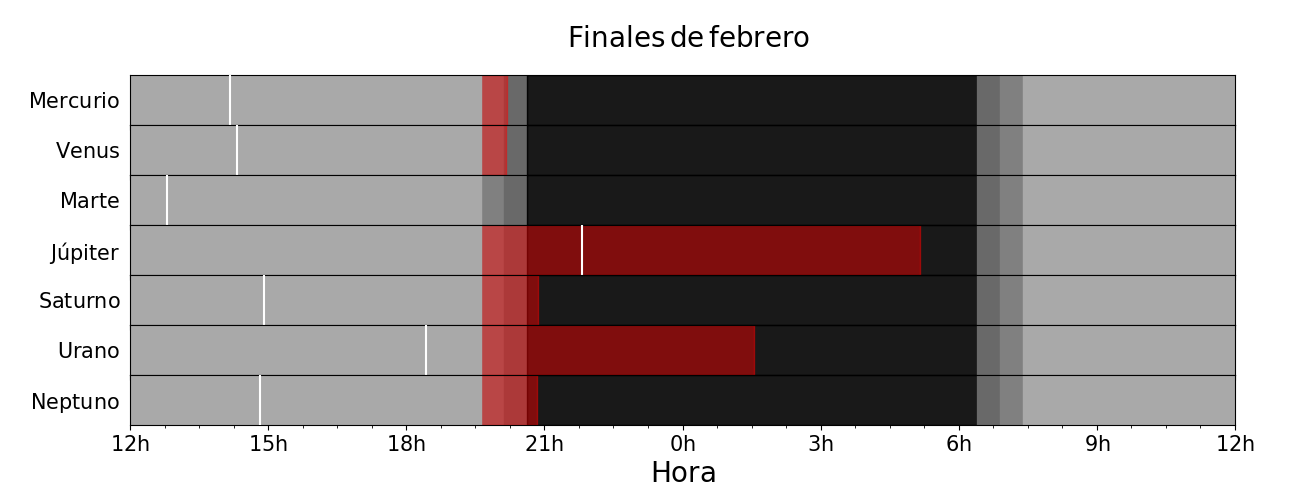
In terms of planets, this is clearly the month of the outer planets (those with orbits beyond Mars). Neither Mercury, Venus, nor Mars will be easily observable these days. However, the main protagonists will be Saturn (still with its tilted rings) and Jupiter, which is gradually moving into a more favorable position for observation. As every month, I’m sharing a table with the main events involving Jupiter’s satellites (Jupiter table). I would highlight the early hours of December 6–7, the afternoon-evening-early morning of December 15–16, and the night of December 30.

Figure 4: Observability of the different planets of the Solar System from Granada in December 2025. In red, the time zone (universal time) during which you will be able to observe the different planets. The vertical white lines indicate the time of the passage of the various planets through the local meridian.
Figure 5: Representation of the sky that will be observable at the end, beginning and middle of a typical December night from Granada (December 14th is chosen as representative). The positions of the planets as well as their motion relative to the fixed stellar background are indicated. For the planets with less apparent motion (Jupiter, Saturn, Uranus and Neptune) a zoom is included for tracking with telescopes.

As for the stars, little by little we are leaving behind the autumn sky (though it is in December when the transition from one season to another truly takes place), and beginning to enjoy the winter sky, dominated by bright stars and a spectacular Milky Way. Moreover, because night falls so early, we can still enjoy, at the start of the evening, objects characteristic of the summer sky. These are good nights to recall our summer adventures and to begin observing the winter constellations.

Figure 6: Representation of the sky that will be observable on a typical December night from Granada. The ecliptic is indicated (dashed line) as well as the main deep sky objects.

From a more down-to-earth perspective, here are also the main sightings of the International Space Station from Granada (ISS table) . We highlight the passes on December 3, 15, and 31, with magnitudes of -3.7, -3.3, and -3.8 respectively, with the last two visible at dawn.

Thus we conclude this brief summary of the astronomical events we will enjoy during December—a month in which we will inaugurate our brand-new H-alpha solar telescope. As always, we remind you that we are open to suggestions on our Telegram channel, where you can also stay up to date with activities, receive timely alerts about easily observable astronomical events, and much more. Here’s the link! We look forward to seeing you soon at our activities. I hope you have a good end and beginning of the year, and that you recharge plenty of energy for the exams that are starting to feel a little too close.

Best of luck—and Clear Skies!

Volver arriba