
Energy, Water & Capacitive Deionization
Energy, Water & Capacitive Deionization
In the context of the global water-energy nexus, our laboratory investigates electrochemical interfaces to develop sustainable solutions. We focus on Capacitive Deionization (CDI) for water treatment and Blue Energy harvesting, combining theoretical physics with advanced surface modification techniques.
Next-Generation Desalination: The "Soft Electrode" Approach
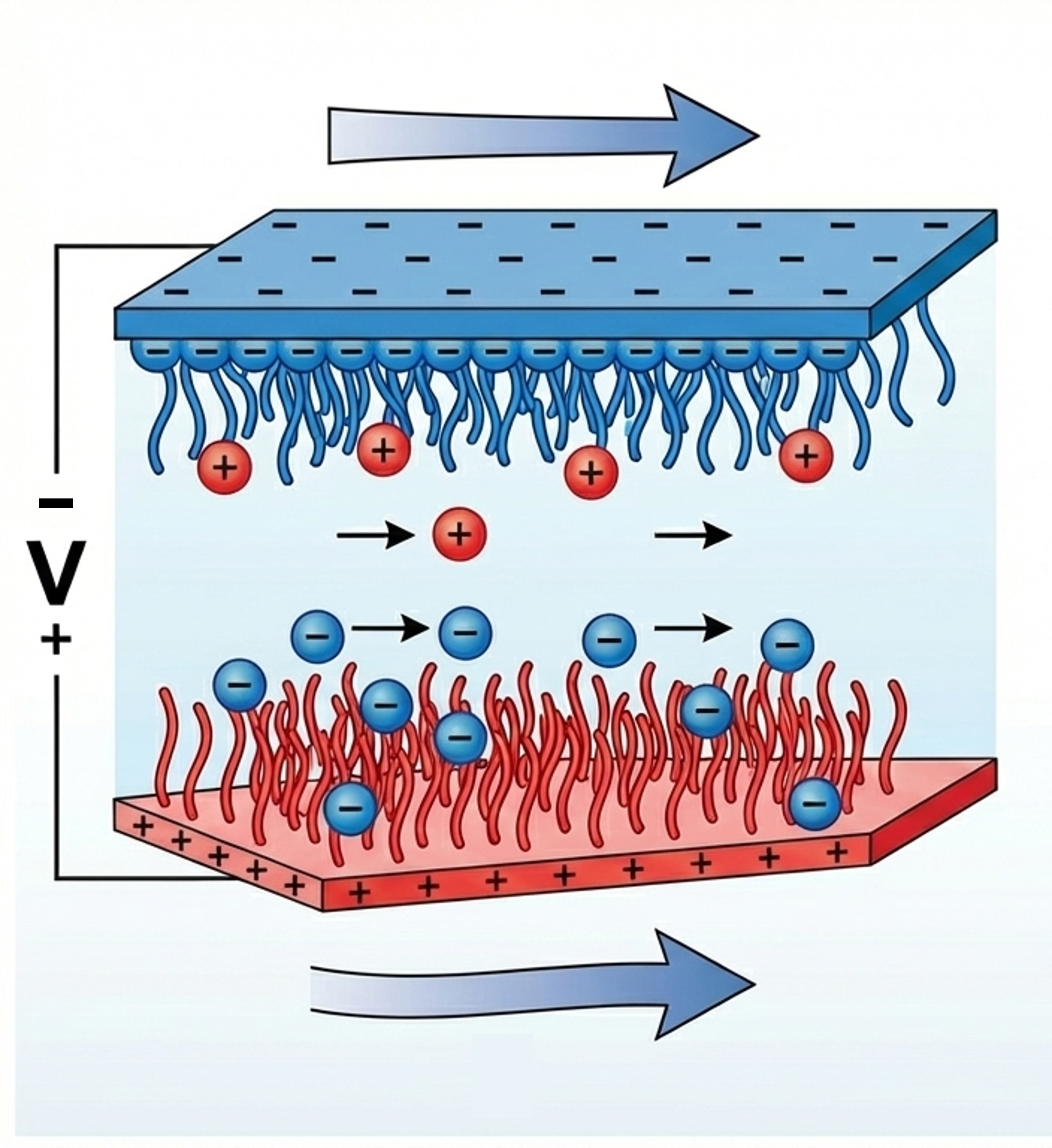
Standard Membrane Capacitive Deionization (MCDI) relies on expensive ion-exchange membranes to improve efficiency. Led by researchers Silvia Ahualli and Juan Antonio Lirio, our group has pioneered a cost-effective alternative: the use of Polyelectrolytes (PEs).
By coating porous activated carbon electrodes with specific charged polymers, we create "Soft Electrodes." This technique creates a selective barrier that mimics the function of a physical membrane but at a fraction of the cost and with lower electrical resistance. Our custom-built cells demonstrate that these layers significantly enhance Charge Efficiency and Salt Adsorption Capacity (SAC) by mitigating co-ion repulsion effects.
Blue Energy Harvesting (CAPMIX)
Beyond desalination, we leverage the reversibility of our systems to harvest renewable energy from salinity gradients, known as "Blue Energy."
Using the principles of Capacitive Mixing (CAPMIX), we employ the same functionalized CDI cells to generate electricity. By cyclically alternating the flow between freshwater (river) and saltwater (sea), we manipulate the expansion and contraction of the Electrical Double Layer (EDL) inside the micropores. Our work focuses on optimizing the power density of these cycles, demonstrating that polyelectrolyte coatings not only aid in desalination but also boost the voltage response during energy extraction.

Theoretical Modeling & Microfluidics
Understanding the physics of ion transport is crucial for optimization. To bridge the gap between theory and real porous electrodes, we utilize microfluidic channels as experimental model systems.
These custom-designed microchannels allow us to visualize and quantify ion dynamics under controlled flow conditions, serving as a validation tool for our robust theoretical models (such as modified Donnan models and porous surface theories). By analyzing how ions move through these simplified geometries, we can accurately predict behavior in complex macropores and adsorption into micropores.
This deep understanding allows us to fine-tune the thickness and charge density of the polyelectrolyte layers, maximizing performance for both water treatment and energy generation.

Open for Collaboration: Electrochemical Testing
Are you developing new carbon materials or polyelectrolytes for electrochemical applications?
At NanoMag Lab UGR, we offer our expertise in CDI and CAPMIX to characterize your materials. We can perform comprehensive electrochemical analysis using our custom flow setups:
- Salt Adsorption Capacity (SAC) and Charge Efficiency tests.
- Long-term stability cycles for desalination and energy harvesting.