Project title
Training, assessment and enablement of people unable to communicate effectively (CONECTA).
Research objectives
Eye-gaze communication boards have been a major step forward for people with very reduced
mobility, but they only work if the user keeps the head in a specific position and
orientation in front of the sensor.
This requires functional head control and an understanding of how eye tracking works. Some
children and people with intellectual disabilities find it very hard to learn this, often
over years and with an uncertain
outcome, and people without head control currently have no alternative at all.
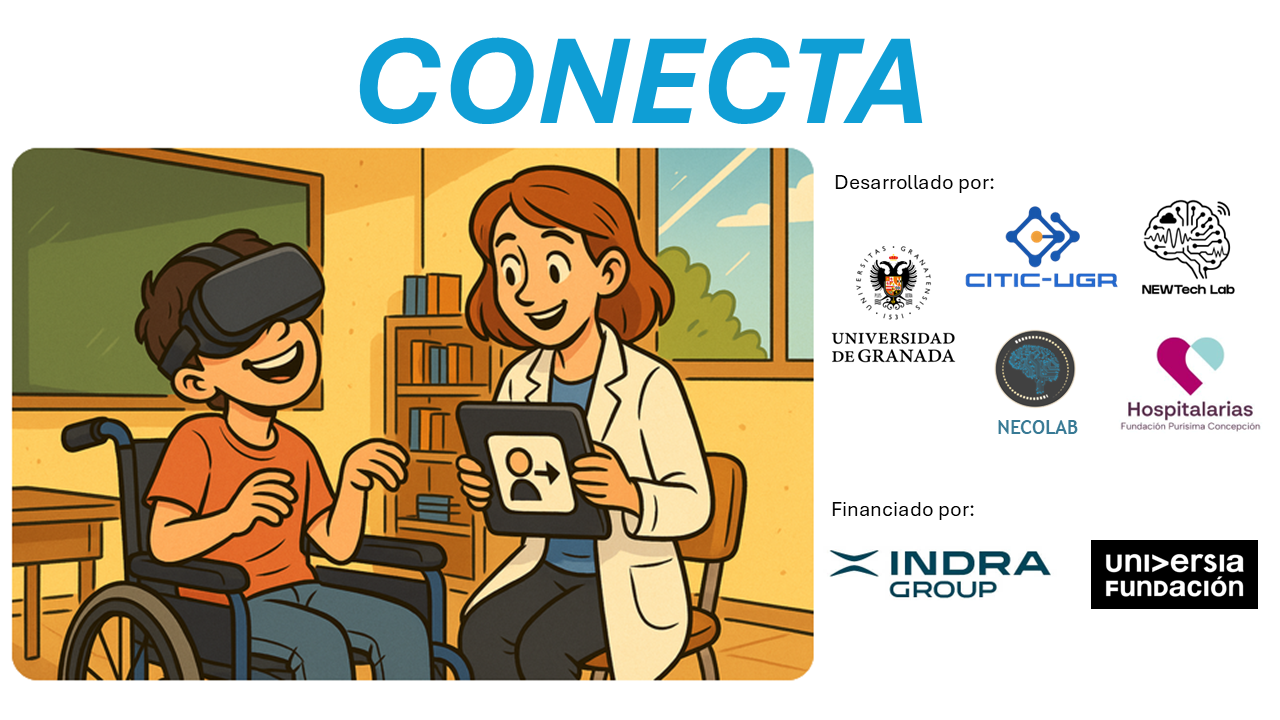
CONECTA proposes an immersive communication system: a communication board displayed in a
virtual or augmented reality headset with eye tracking. The board follows the user’s head
and gaze even when the user cannot
control them, and intelligent algorithms distinguish the intention to look at a cell from
involuntary or erratic movements. The project pursues three objectives:
- O1. Design and develop a system able to train, assess and enable
communication in people with communication challenges and restricted motility or
impaired regulation of movement in space,
who cannot use current augmentative and alternative communication (AAC) systems.
- O2. Evaluate and validate the prototype with students of the partner
school.
- O3. Disseminate and transfer CONECTA to the community of users,
families and professionals through publications, outreach events, multimedia material
and social media.
The system
Collaborators
CONECTA is a multidisciplinary project. Researchers from the Neural Engineering and Computing
Lab (NECO Lab, CITIC-UGR), with long experience in biosignal processing, human-machine
interaction and studies with people,
work together with the professionals of the special education school of Hospitalarias Fundación Purísima
Concepción in Granada, a reference and support centre
recently awarded the Princess of Girona Foundation School of the Year prize. Its
physiotherapists, speech therapists, occupational therapists and special education teachers
define the design requirements and take part
in the validation with their students.
Impact
CONECTA is aimed at people with communication challenges together with problems of head
control or learning difficulties, a profile present in conditions such as cerebral palsy,
amyotrophic lateral sclerosis,
Rett syndrome, Angelman syndrome or acquired brain injury, among others.
An impact study carried out at the partner school among its 113 students found that CONECTA
would give 20 students who currently have no gaze-based access the chance to train it, and
would improve the training of
9 more: 26% of all students. Students with autism spectrum disorder or attention
difficulties could also benefit by working on attention and task persistence, so nearly 70%
of the school’s students could benefit from
the project.
Principal investigator
Dr. Eng. Assoc. Prof. Miguel Angel Lopez Gordo (malg@ugr.es)
Neural Engineering and Computing Lab (NECO Lab, CITIC-UGR)
NEWTech research group (TIC-268)
Dpt. Signal Theory, Telematics and Communications
University of Granada

 Twitter
 E-mail