|
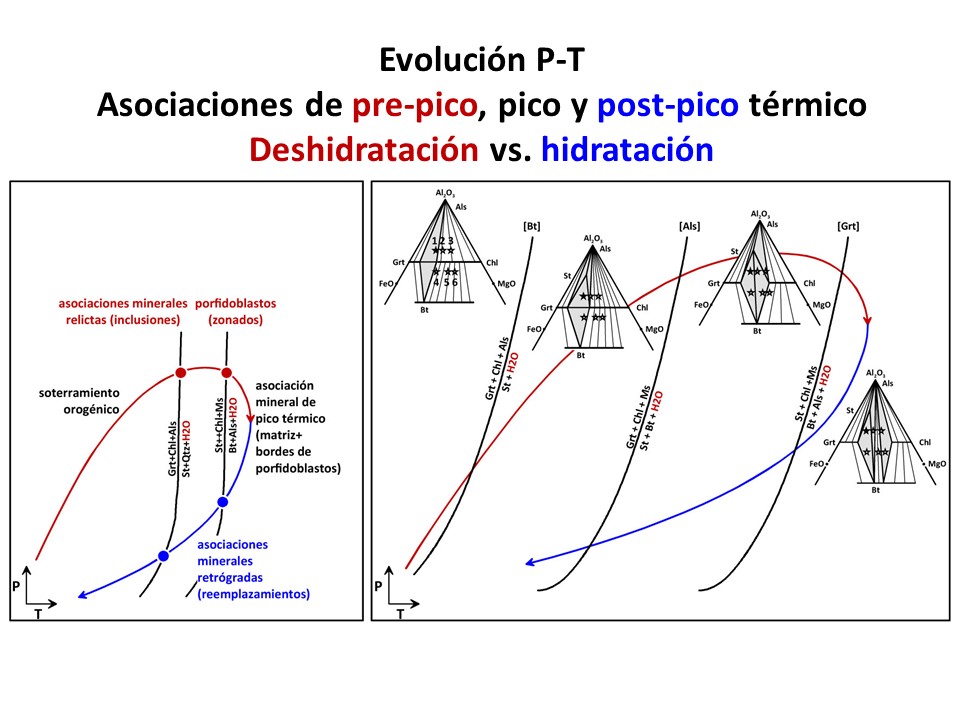
What
causes contrasting P-T paths of HP rocks in the same subduction
complex?
Take a
look at the video!

Gradientes térmicos continentales, oceánicos (en
función de la edad de la litosfera) y a lo largo de Moho oceánica (7 km) subducida.

The dry solidii
of KLB-1 lherzolite are from Takahashi et al. (2004,
T93), Herzberg et al. (2004,
H00) and Jennings and Holland (2004,
JH15), of DMM lherzolite is from Stolper et al. (2004,
S20, including the stabilities of Grt, Spl and Pl) and of
harzburgite is from
Maaløe (2004,
M04). The
oceanic and continental geotherms are by Turcotte and Schubert (2002;
TS02), Priestley et al. (2024,
P24) and Xu et al. (2025,
X25), the normal adiabat with a mantle potential temperature of 1350
ºC is by Katsura (2022,
K22), the hot adiabat with a mantle potential temperature of 1500 ºC
is drawn parallel to the normal mantle adiabat, and the subducted
Moho of warm (young) oceanic lithosphere is from Peacock and Wang (1999,
PW99) and Syracuse et al. (2010,
S10, range).
The lithosphere-asthenosphere boundary (LAB) is located at varied
depths in the range from <50 km to 250 km where the geothermal
gradient becomes convective (adiabat). The pressure-depth profile is as in Katsura (2022).
Geoterma continental estable

Web de J. Brady (arriba):
https://www.science.smith.edu/~jbrady/petrology/metrocks-topics/where-why/why-figure11.php
Web de J. Brady (pdf abajo):
https://www.science.smith.edu/~jbrady/petrology/metrocks-topics/where-why/why-figure12.php

Con Excel
 ·
·
Con MathCad


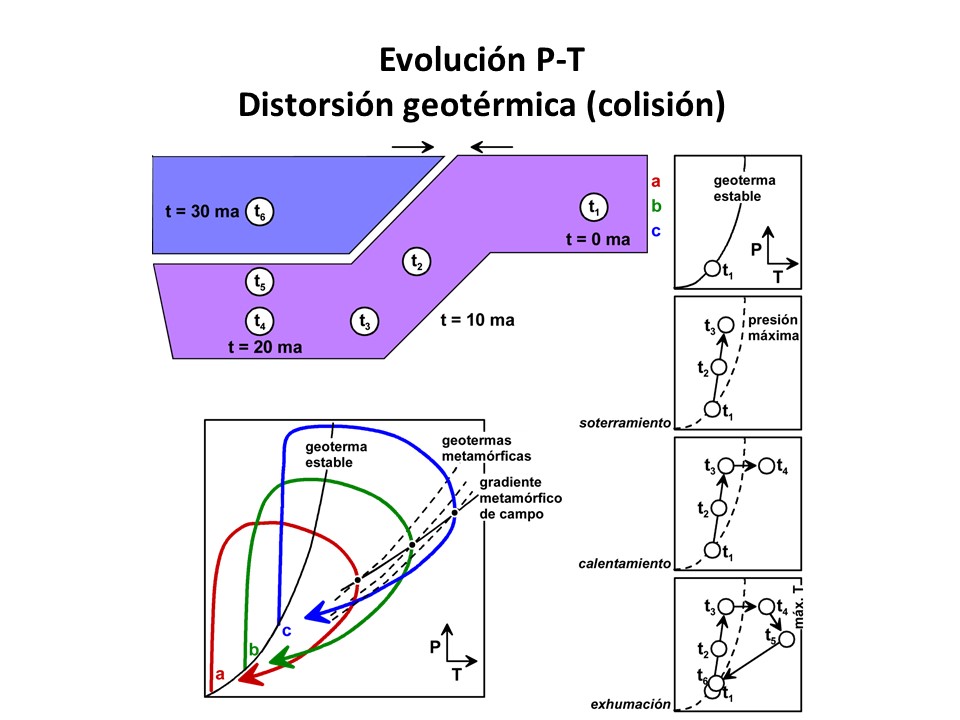
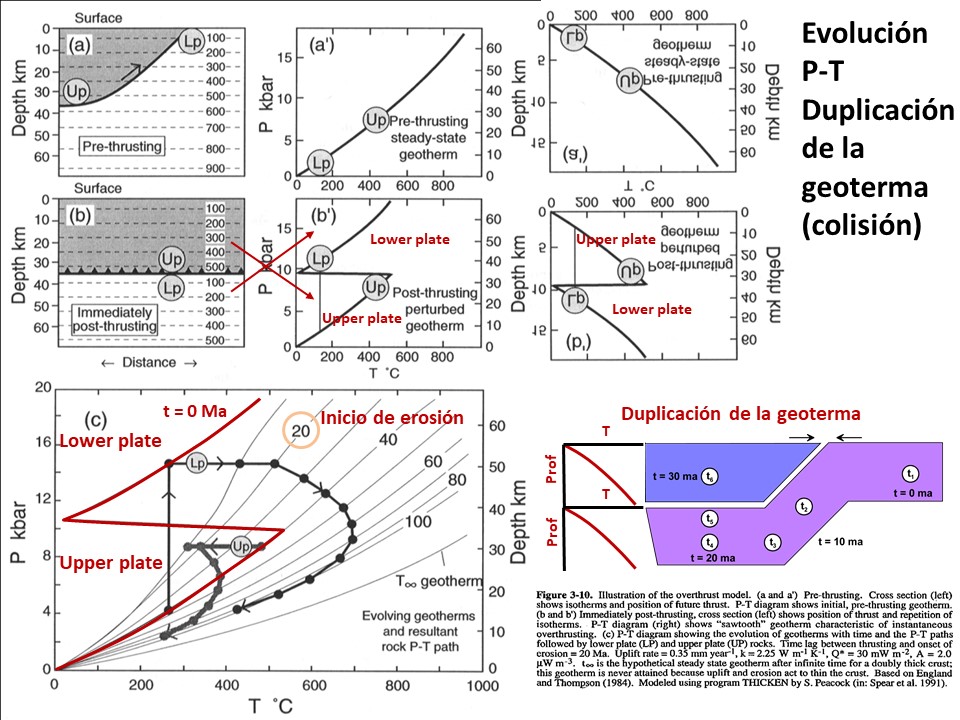
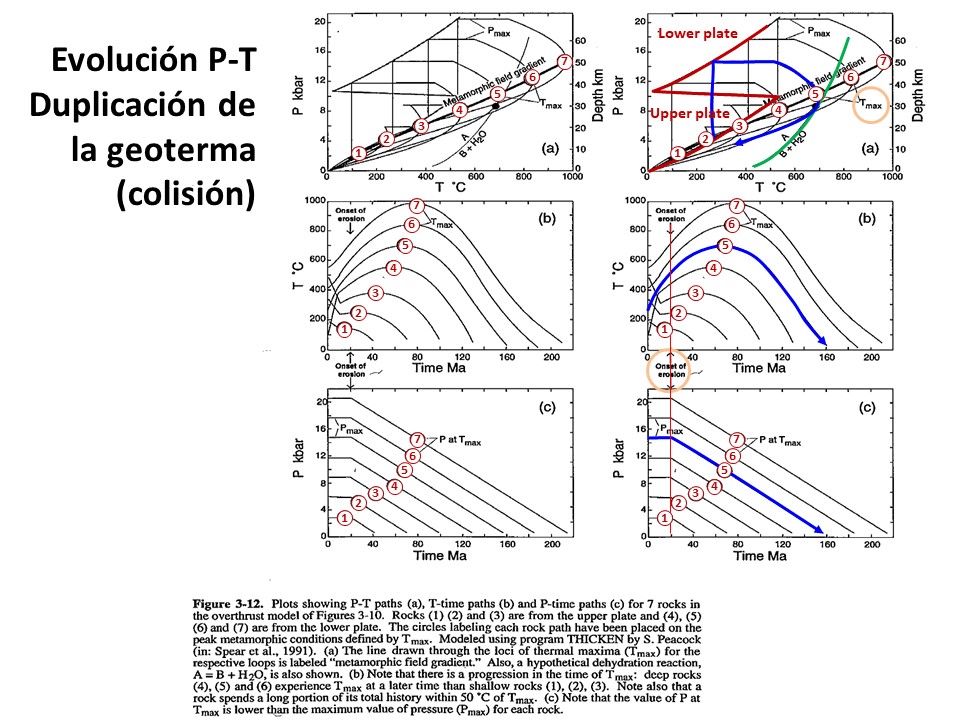
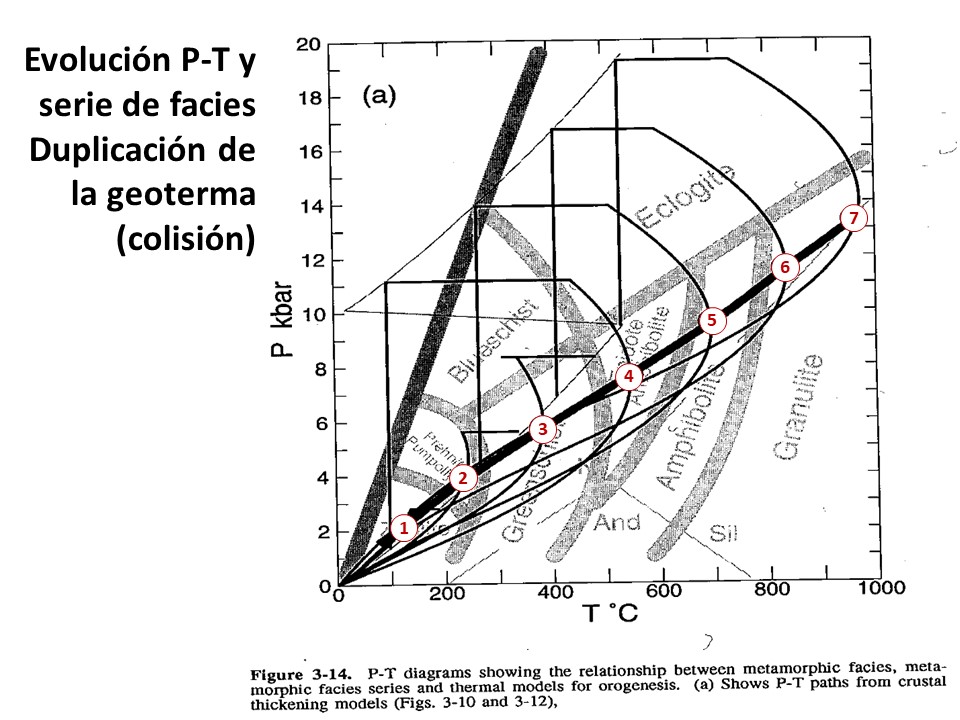
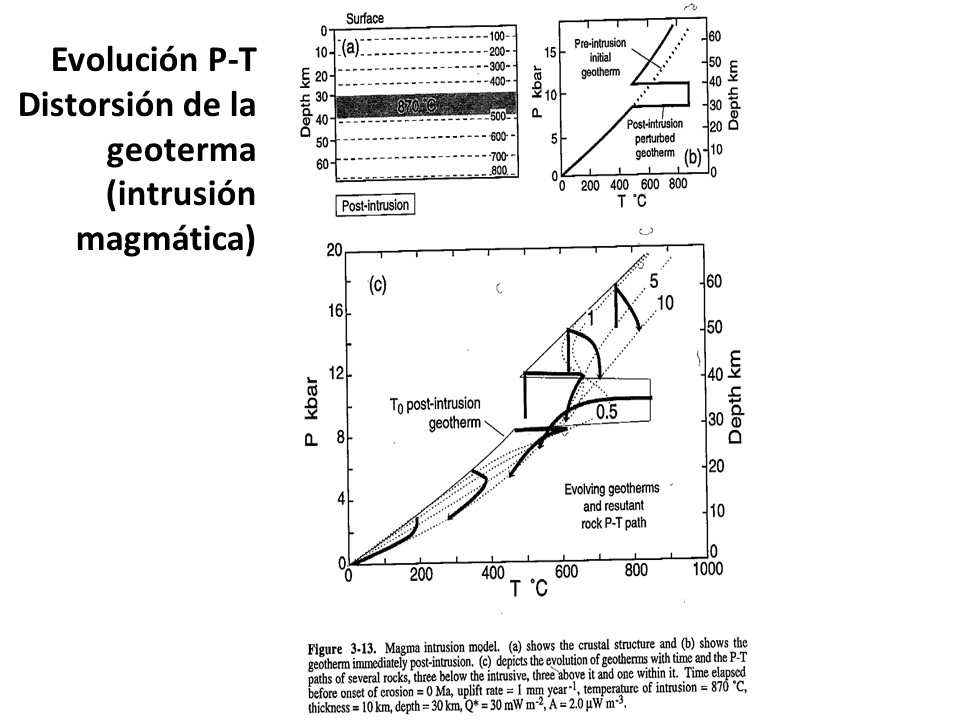
Colisión continental
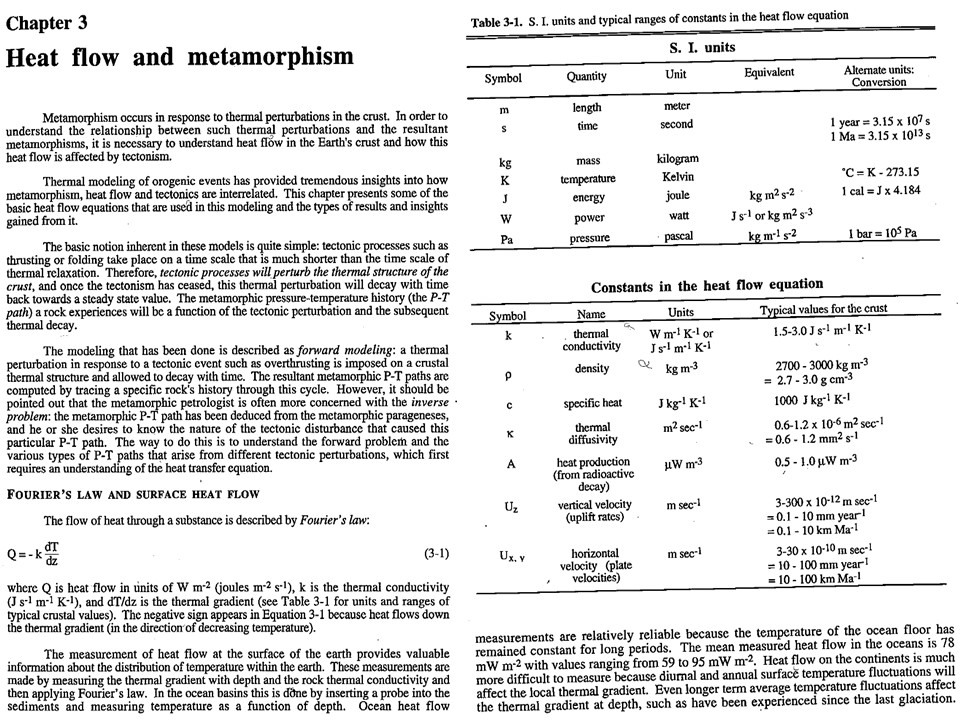
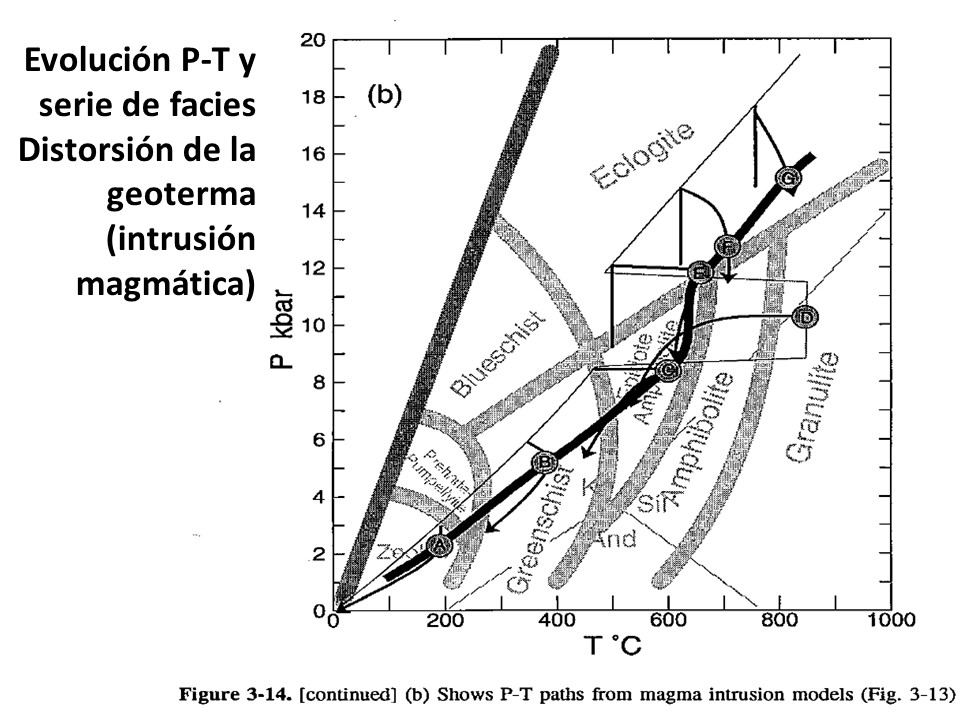
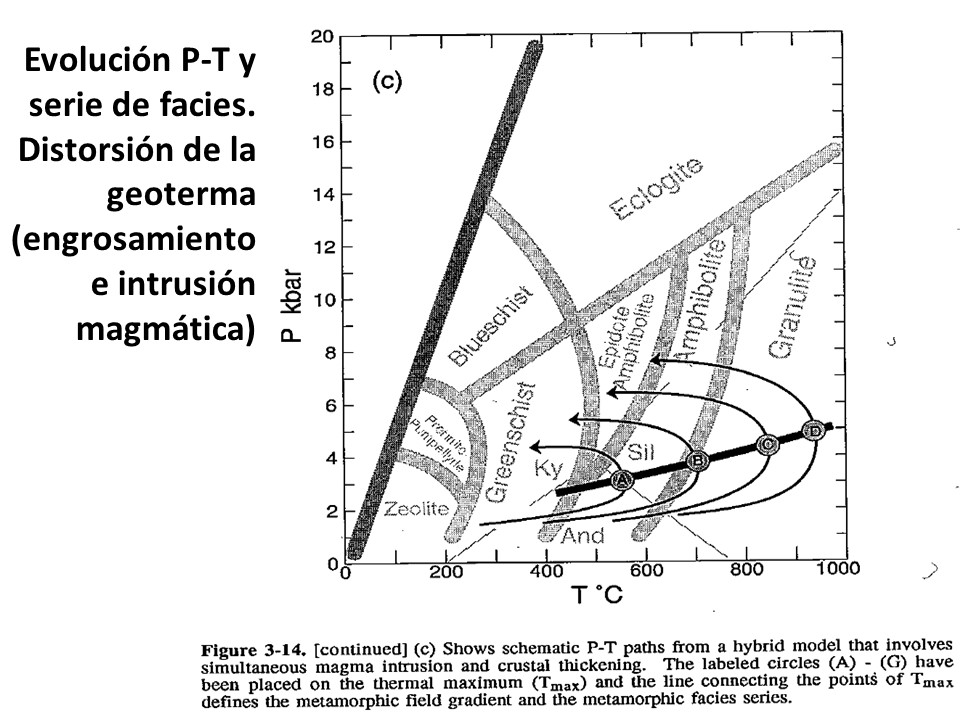
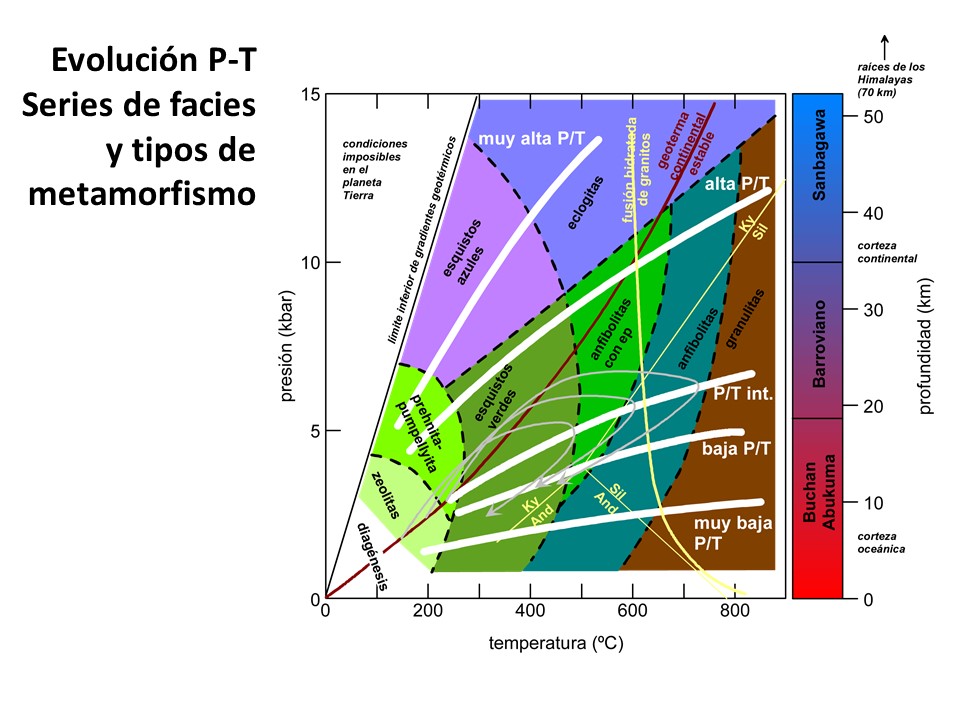
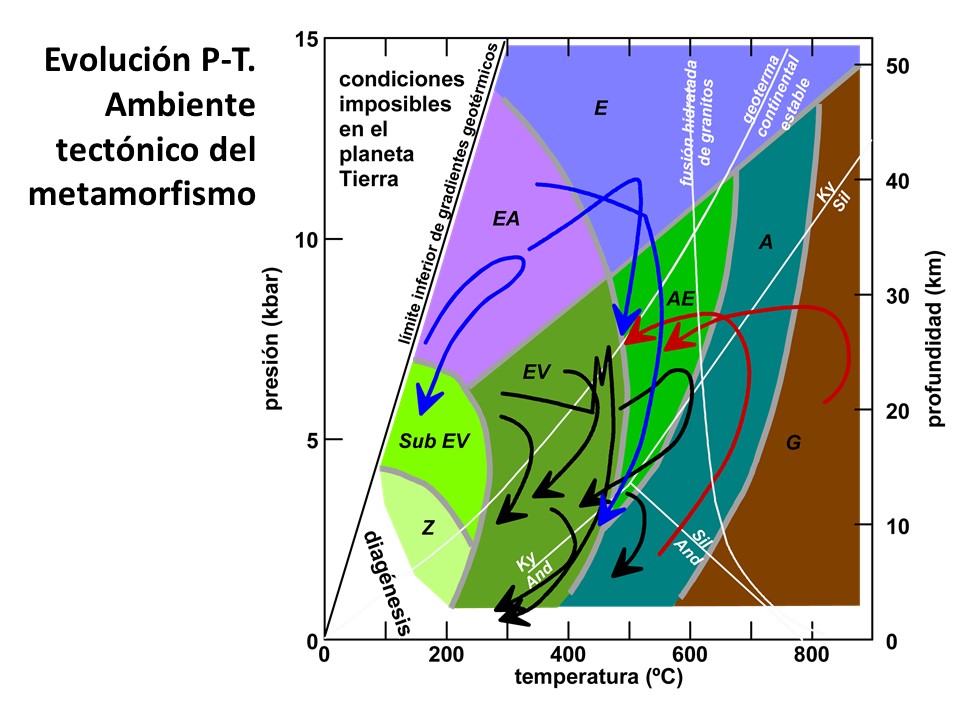
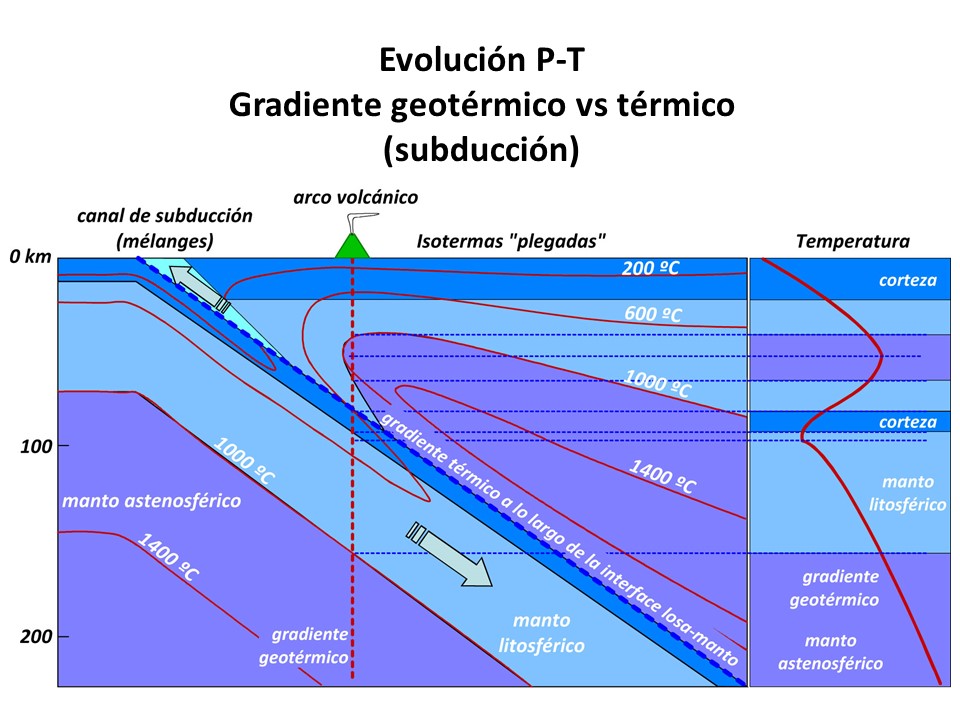

Global range of subduction.
Vea:
Peacock, S.M., Wang, K.
(1999) Seismic Consequences of Warm Versus Cool Subduction Metamorphism: Examples from Southwest and Northeast Japan. Science 286, 937-939. DOI: 10.1126/science.286.5441.937.
Syracuse, E.M., van Keken, P.E. & Abers, G.A.
(2010) The global range of subduction zone thermal models. Phys. Earth Planet. Inter. 183, 73–90.
Para saber más sobre eclogitas:
https://www.ccgm.org/es/eclogitas-rocas-selectas/
Para saber más sobre eclogitas de Sierra Nevada, pica en las imágenes.


What
causes contrasting P-T paths of HP rocks in the same subduction
complex?
Basado en una presentación suministrada por
Taras V. Gerya en marzo de 2021.
Véase: Taras
V. Gerya Bernhard Stöckhert Alexey L. Perchuk (2002). Exhumation of
high‐pressure metamorphic rocks in a subduction channel: A numerical
simulation. Tectonics Volume 21, Issue 6, Pages 6-1-6-19.
https://doi.org/10.1029/2002TC001406
Música: Get
Back, The Beatles, Rooftop Concert, London, 30 de enero de 1969.
Un ejemplo de
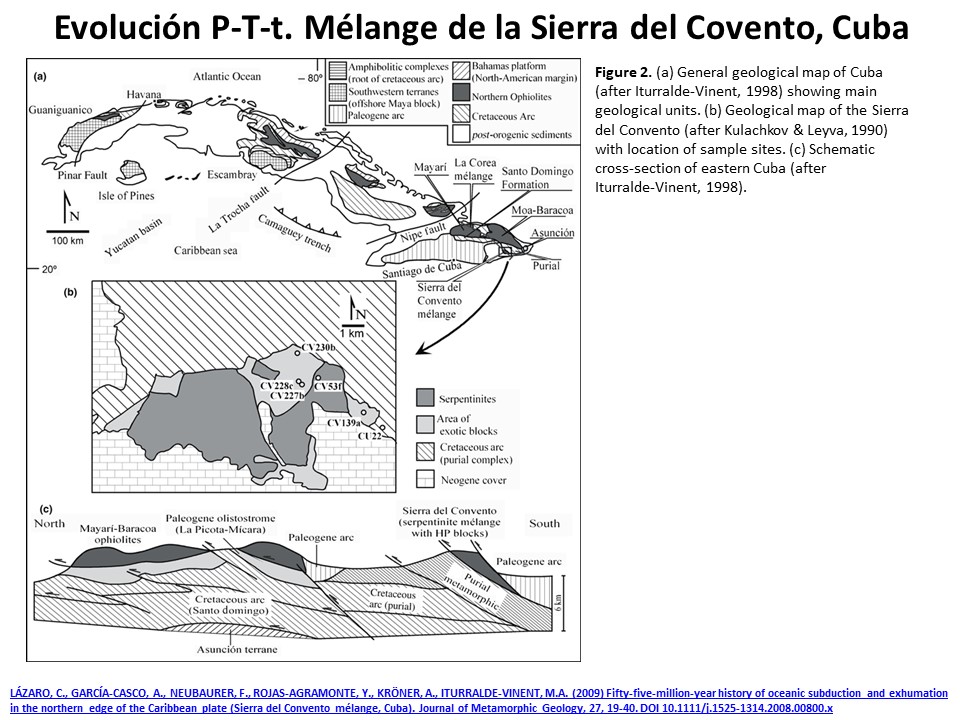
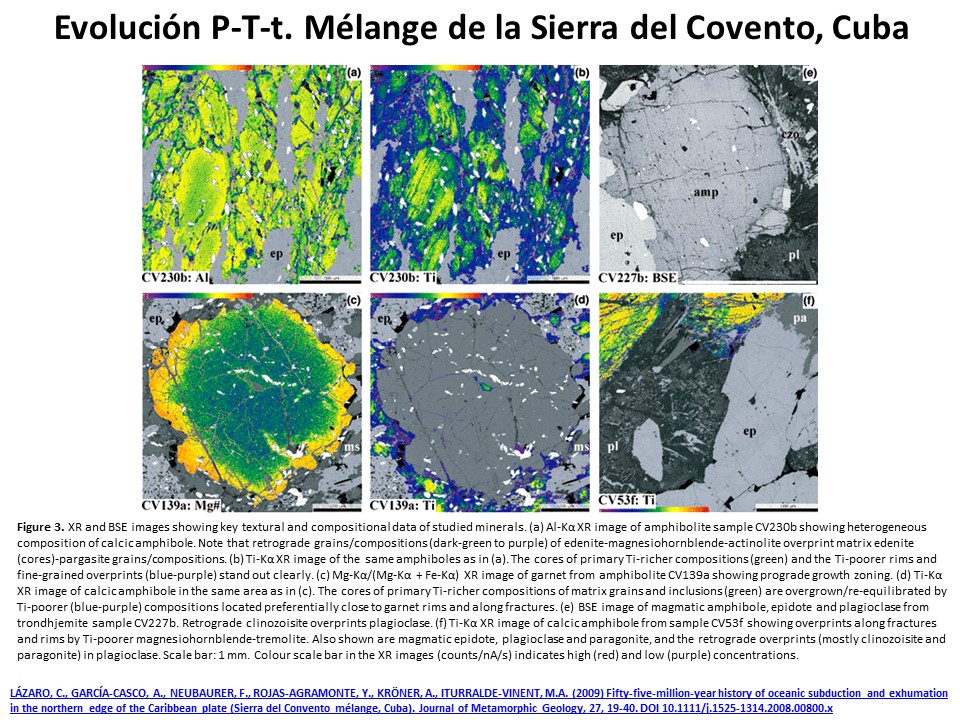
evolución P-T-t: Mélange de la Sierra del Convento, Cuba
Información está extraída de:
LÁZARO, C., GARCÍA-CASCO, A., NEUBAURER, F., ROJAS-AGRAMONTE, Y.,
KRÖNER, A., ITURRALDE-VINENT, M.A. (2009) Fifty-five-million-year
history of oceanic subduction and exhumation in the northern edge of
the Caribbean plate (Sierra del Convento mélange, Cuba). Journal of
Metamorphic Geology, 27, 19-40. DOI 10.1111/j.1525-1314.2008.00800.x
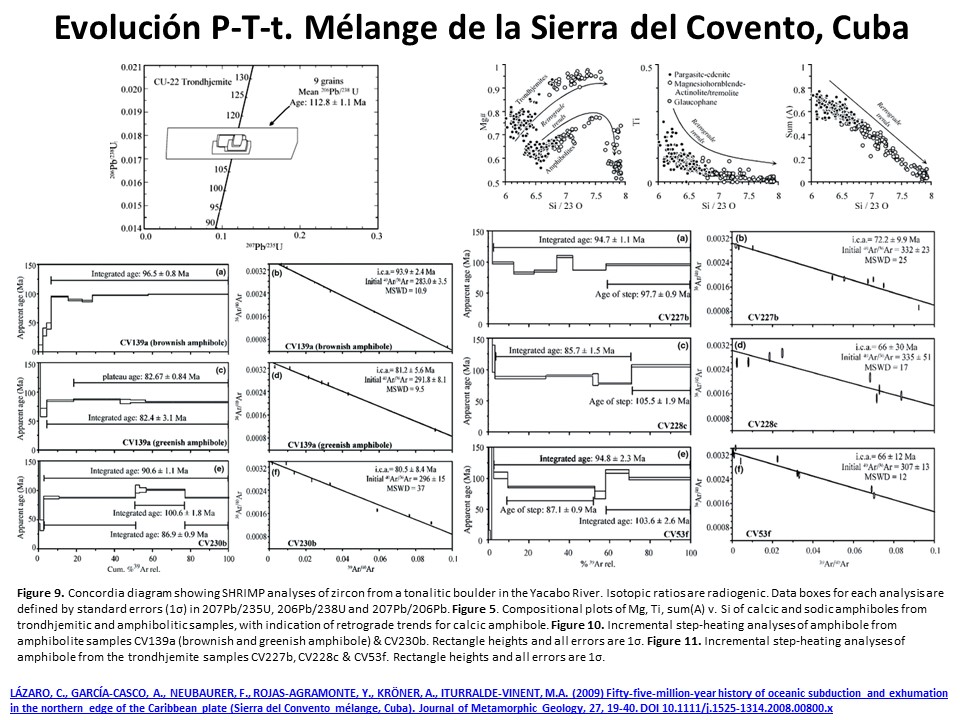
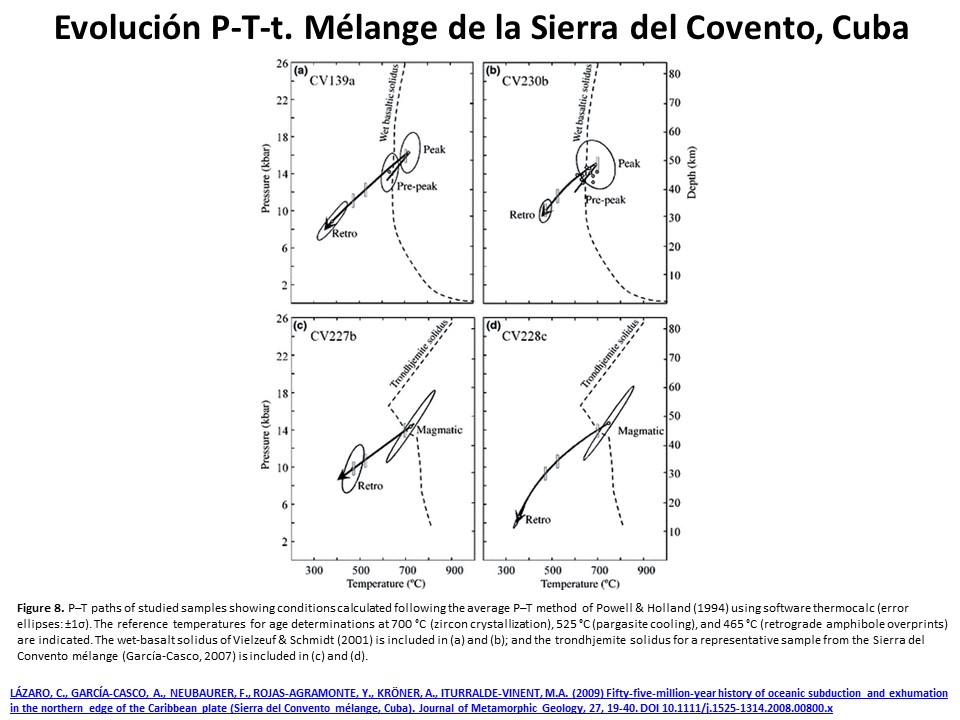
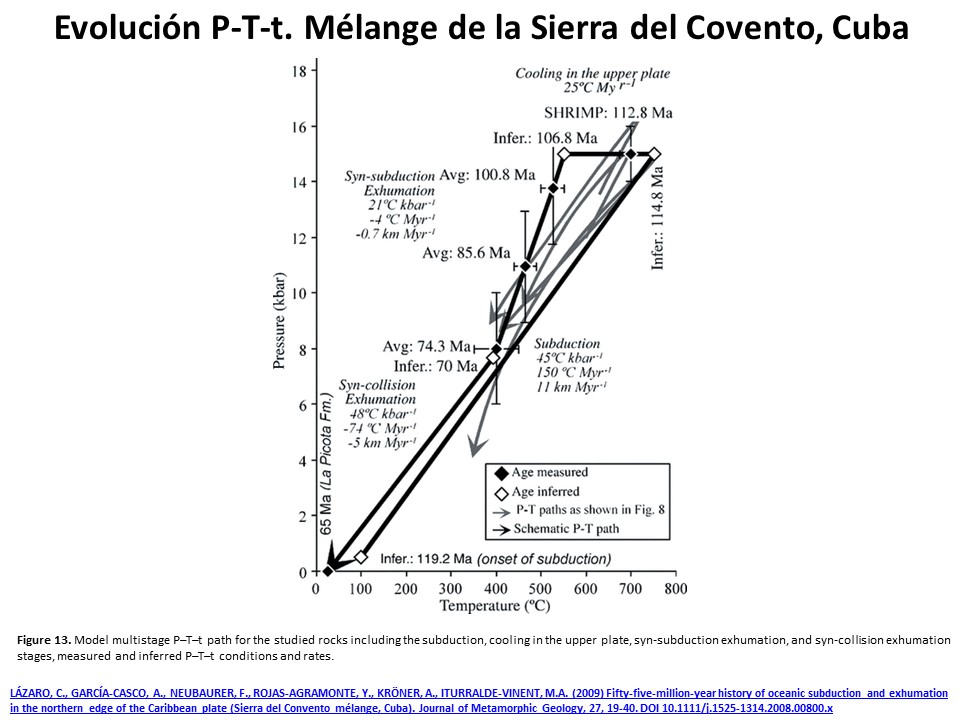
ABSTRACT. Petrological and
geochronological data of six representative samples of exotic blocks
of amphibolite and associated tonalite‐trondhjemite from the
serpentinitic mélange of the Sierra del Convento (eastern Cuba)
indicate counterclockwise P–T paths typical of material subducted in
hot and young subduction zones. Peak conditions attained were ca.
750 °C and 15 kbar, consistent with the generation of tonalitic
partial melts observed in amphibolite. A tonalite boulder provides a
U‐Pb zircon crystallization age of 112.8±1.1 Ma, and Ar/Ar amphibole
dating yielded two groups of cooling ages of 106–97 Ma (interpreted
as cooling of metamorphic/magmatic pargasite) and 87–83 Ma (interpreted
as growth/cooling of retrograde overprints). These geochronological
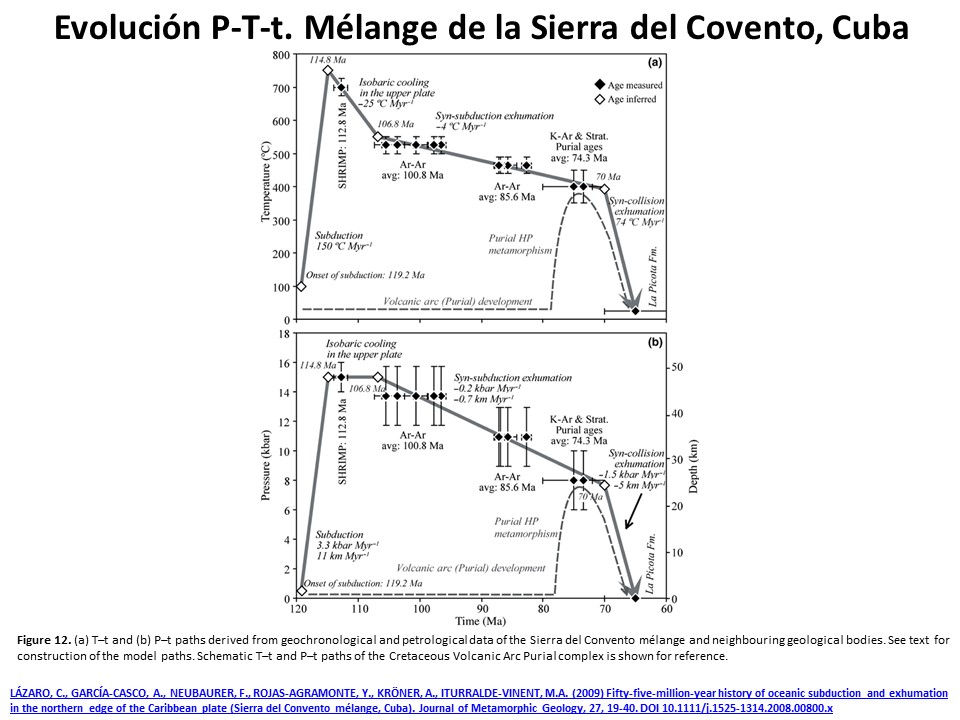
data, in combination with other published data, allow the following
history of subduction and exhumation to be established in the region:
(i) a stage of hot subduction 120–115 Ma, developed upon onset of
subduction; (ii) relatively fast near‐isobaric cooling (25 °C·Myr−1)
115–107 Ma, after accretion of the blocks to the upper plate
lithospheric mantle; (iii) slow syn‐subduction cooling (4 °C·Myr−1)
and exhumation (0.7 km·Myr−1) in the subduction channel 107–70 Ma;
and (iv) fast syn‐collision cooling (74 °C·Myr−1) and exhumation (5
km·Myr−1) 70–Ma.
Fusión parcial en el manto

Yaoling Niu (2021) Lithosphere thickness controls the extent of
mantle melting, depth of melt extraction and basalt compositions in
all tectonic settings on Earth – A review and new perspectives.
Earth-Science Reviews 2021, 103614.
https://www.sciencedirect.com/science/article/pii/S0012825221001148?via=ihub#f0015
Geoterma
terrestre vs solidus y liquidus de harzburgita hasta la transción
manto-núcleo (2900 km, 136 GPa, 3500-4000 K)

Composición
mineralógica del manto

Stixrude, L., Lithgow-Bertelloni, C. 2012. Geophysics of Chemical
Heterogeneity in the Mantle. Annual Review of Earth and Planetary
Sciences Volume 40, 569-595.
https://doi.org/10.1146/annurev.earth.36.031207.124244.
Faccenda, M. & Dal Zilio, L. 2017. The role of solid–solid phase transitions
in mantle convection. Lithos, 268–271, 198-224.
https://doi.org/10.1016/j.lithos.2016.11.007
Evolución termo-química
del manto 3000 Ma - presente

The proposed changes through Earth’s history in the behavior of
mantle plumes, illustrated from 3 billion years ago to present in a
clockwise direction. The model assumes that the mantle has been
cooling by 100 Kelvin every billion years, leading to changes in the
behavior of the transition zone near 500 km depth and its influence
on rising plumes. The blue layer at the outer boundary indicates the
thermal lithosphere, which becomes thicker as the mantle temperature
decreases.
Comment Paul Asimow, Editor, Geochemistry, Geophysics, Geosystems.
Li, R., Dannberg, J., Gassmöller, R., Lithgow-Bertelloni, C., &
Stixrude, L. (2025). How phase transitions impact changes in mantle
convection style throughout Earth’s history: From stalled plumes to
surface dynamics. Geochemistry, Geophysics, Geosystems, 26,
e2024GC011600.
https://doi.org/10.1029/2024GC011600
|