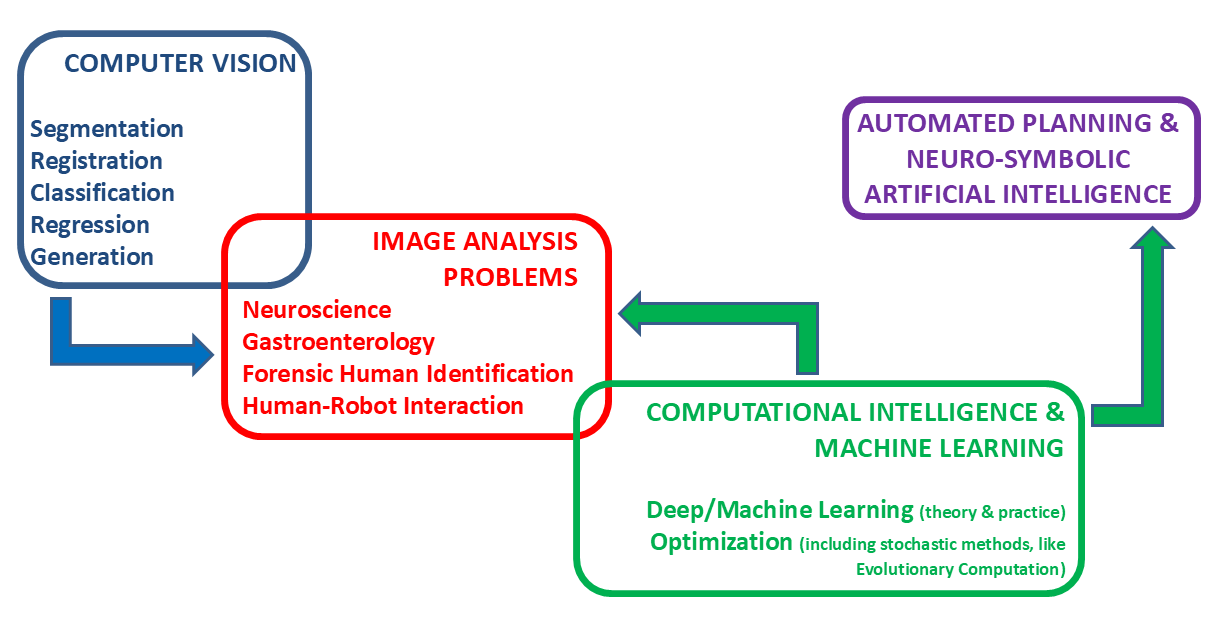
My principal areas of interest are computer vision, machine/deep learning and computational intelligence methods mainly, but not exclusively, applied to the resolution of biomedical image analysis problems. In recent years, and as a result of my teaching duties at the University of Granada, I have begun to delve into automated planning and the hybridization of symbolic and subsymbolic methods for sequential decision-making.
Computer Vision is the scientific field which studies the computational interpretation of images.
Machine Learning is concerned with the design and development of algorithms that allow computers to improve their performance over time based on data. “Learning denotes changes in the system that are adaptive in the sense that they enable the system to do the same task (or tasks drawn from a population of similar tasks) more effectively the next time.” (Herbert Simon). There is a fundamental difference between classification and regression problems: classification is about predicting a label (e.g., sex estimation from facial images) and regression is about predicting a quantity (e.g., age estimation from facial images).
Deep learning "allows computational models that are composed of multiple processing layers to learn representations of data with multiple levels of abstraction. These methods have dramatically improved the state-of-the-art in speech recognition, visual object recognition, object detection and many other domains such as drug discovery and genomics. Deep learning discovers intricate structure in large data sets by using the backpropagation algorithm to indicate how a machine should change its internal parameters that are used to compute the representation in each layer from the representation in the previous layer. Deep convolutional nets have brought about breakthroughs in processing images, video, speech and audio, whereas recurrent nets have shone light on sequential data such as text and speech." (from the abstract of the paper "Deep learning" by LeCun, Bengio and Hinton, Nature, 2015)
Computational intelligence techniques are computing methods not based on closed-form solutions (e.g., a formula which solves a specific equation), but mostly on search/optimization procedures and other "approximate" techniques which are able to solve problems also in the presence of qualitative, uncertain, imprecise and incomplete information. The main soft computing paradigms are Artificial Neural Networks, Evolutionary Computation, Swarm Intelligence, Fuzzy Logic and Probabilistic Reasoning. They are a set of computational techniques to solve problems by imitating nature’s approaches.
Automated Planning is the branch of artificial intelligence that focuses on the development of algorithms that automatically devise a sequence of actions (a plan) to achieve a specific goal from a given initial state. Planning problems are typically represented using planning domains defined in languages like PDDL (Planning Domain Definition Language).
Neuro-symbolic Methods: Automated planning has traditionally relied on symbolic approaches based on logical representations and reasoning. However, recent work has explored subsymbolic methods, such as neural networks and reinforcement learning, to learn representations and decision policies directly from data. The hybridization of symbolic and subsymbolic methods aims to combine the capabilities of learning-based systems with the expressiveness and interpretability of symbolic reasoning.
Image Segmentation is defined as the partitioning of an image into non overlapping regions that are homogeneous with respect to some visual feature such as color or texture. The practical applications of segmentation algorithms range from medical imaging (measurement of organ sizes/volumes, study of anatomical structures, quantitative tissue analysis, etc.) to object detection (faces, pedestrians, satellite images, etc.), traffic control systems or video surveillance.
Image Registration is the task of applying some transformations to two images so that they match as best as possible. In other words, it refers to the process of geometrically aligning multiple images having some shared content. It is central to many tasks in computer vision, medical imaging, augmented reality and robotics.
Artificial Neural Networks are computational models based on the structure and functions of biological neural networks. They are computing systems made up of simple and highly interconnected processing elements which process information by their dynamic response to external inputs. "The importance of neural networks [in pattern recognition] is that they offer a very powerful and very general framework for representing non-linear mappings from several input variables to several output variables, where the form of the mapping is governed by a number of adjustable parameters." (Christopher Bishop)
Evolutionary Computation includes several computational models that reproduce natural evolution processes to optimize a goal which is generally represented as a function. These methods are commonly applied to the verification of hypotheses in biology or sociology through simulations, the optimization of continuous and combinatorial functions, and, in general, in the resolution of hard problems (large, complex and poorly understood search spaces) where enumerative, local search or gradient-based search methods are inappropriate.
Ensemble Classifiers combine multiple learning algorithms to obtain better predictive performance than could be obtained from any of the constituent learning algorithms.