High Pressure rocks of
Margarita, Venezuela.
Field Trip. November
11-15, 2010
High Pressure rocks of
Margarita, Venezuela.
Field Trip. November
11-15, 2010
High Pressure rocks of
Margarita, Venezuela.
Field Trip. November
11-15, 2010
Leaders and paricipants
Leaders:
Walter V. Maresch (Ruhr-Universität Bochum, Germany, walter.maresch@rub.de)
Franco Urbani (FUNVISIS & Universidad Central de Venezuela, Fundación Venezolana de Investigaciones Sismológicas, urbanifranco@yahoo.com)
Hans-Peter Schertl (Ruhr-Universität Bochum, Germany, hans-peter.schertl@rub.de)
Klaus P. Stanek (TU Bergakademie Freiberg, Germany, stanek@geo.tu-freiberg.de)
Participants:
1 Patxi Viscarret Universidad de Los Andes Venezuela patxiviscarret@yahoo.com 2 David Mendi UCV Venezuela davidmendi@gmail.com 3 Ruthman Hurtado UCV Venezuela 4 Sebastian Grande UCV Venezuela sgrande52@gmail.com 5 Enrique Navarro UCV Venezuela enriquenf@gmail.com 6 Franco Urbani UCV Venezuela urbanifranco@yahoo.com 7 Hans Peter Schertl Ruhr Uni Bochum Germany hanspeter.schertl@rub.de 8 Klaus Stanek TU Freiberg Germany stanek@geo.tu-freiberg.de 9 Walter Maresch Ruhr Uni Bochum Germany walter.maresch@rub.de 10 Jim Pindell Tectonic Analysis- Uni Wales UK jim@tectonicanalysis.com 11 Uwe Martens Tectonic Analsysis – Stanford Uni USA umartens@zoho.com 12 Jorge Julian Restrepo Universidad Nacional de Colombia Colombia jjrestrepoa@fastmail.fm 13 Marion Weber Universidad Nacional de Colombia Colombia mweber@unal.edu.co 14 Javier Escuder-Viruete Instituto Geologico y Minero de España España j.escuder@igme.es
The metamorphic rocks of Margarita Island, Venezuela, have been studied and their significance debated for more than 60 years. As paradigms in the Geosciences changed, ideas guiding tectonic and geodynamic interpretations also changed. A survey of the literature on this fascinating island shows shifts from "fixist" ideas and application of classical stratigraphic nomenclature to highly metamorphosed and deformed rocks, through to interpretations calling on extreme nappe development from a classical Alpine viewpoint. Recent discussions on the origin and evolution of the Caribbean Plate, aptly summarized in an impressive compendium of 31 papers edited by James, Lorente & Pindell (2009), underscore that understanding the geology of Margarita Island is a key element in understanding the timing and nature of interaction of the Caribbean plate with northern South America.
In the James et al. (2009) volume, Maresch et al. (2009) presented a brief overview of the metamorphic rock series exposed on Margarita Island and proposed a model to link the Cretaceous geological evolution of the island with a scenario involving interaction of the Caribbean plate with NW South America beginning in the Aptian/Albian. This key pre-Cenozoic history is arguably the most contentious part of various interpretations on Margaritan evolution (cf., Maresch, 1975; Chevalier et al., 1988; Guth & Avé Lallemant, 1991; Stöckhert et al., 1995; Rekowski & Rivas, 2005; Higgs, 2009, and references therein), but we believe the suggestion of Maresch et al. (2009) seems to align presently available data in the most plausible and consistent manner. In their abstract Maresch et al. (2009) state (see also Fig. 3):
“The metamorphic rock sequences exposed on the Island of Margarita, Venezuela, located in the southeastern corner of the Caribbean plate margin, are composed of a high-pressure/low-temperature (HP/LT) nucleus subducted to at least 50 km depth, now structurally overlain by lower-grade greenschist-facies units lacking any sign of high-pressure subduction-zone metamorphism. The HP/LT nucleus involves protoliths of both oceanic (metabasalts and intimately associated carbonaceous schists of the La Rinconada unit; peridotite massifs) and continental affinity (metapelites, marbles and gneisses of the Juan Griego unit). All HP/LT units were joined together prior to the peak of high-pressure metamorphism, as shown by their matching metamorphic pressure-temperature evolution. The metamorphic grade attained produced barroisite as the regional amphibole. Glaucophane is not known from Margarita. Contrary to a widely propagated assumption, there are no major nappe structures post-dating HP/LT metamorphism anywhere within the high-pressure nucleus of Margarita Island. U-Pb zircon dating of key tonalitic to granitic intrusive rocks provides the following constraints: 1) the Juan Griego unit is heterogeneous and contains Palaeozoic as well as probable Mesozoic protolith; 2) the peak of HP/LT metamorphism, i.e. maximum subduction, is younger than 114–106 Ma and older than 85 Ma, most probably c. 100–90 Ma, a time span during which the southeastern Caribbean/South American border was clearly a passive margin. The assembly of Margaritan protoliths and their HP/LT overprint occurred far to the west in northwestern South America, a scenario completely in accord with the details of the Pacific-origin model outlined by Pindell & Kennan (2009). Juxtaposition of the greenschist-facies units occurred after exhumation into mid-crustal levels after c. 80 Ma.”
Fig. 1: Landsat image of Margarita Island and the islands of Coche and Cubagua to the south.
Fig. 2: View along the north coast of Margarita Island.
Fig. 3: Simplified sketch map of the metamorphic rocks of Margarita Island. Adapted from MARESCH et al. (2009)
There is a broad consensus on subsequent history (e.g., Chevalier et al., 1988; Stöckhert et al., 1995; Avé Lallemant, 1997; Rekowski & Rivas, 2005; and references therein), calling for multi-stage uplift in a complex sinistral transpressional regime, during which Margarita Island was hauled to the east along the northern margin of South America. This transport imposed strong, increasingly heterogeneous shear deformation extending from the ductile to the brittle regime, resulting in the present pervasive NNE-SSW structural grain of the Island.
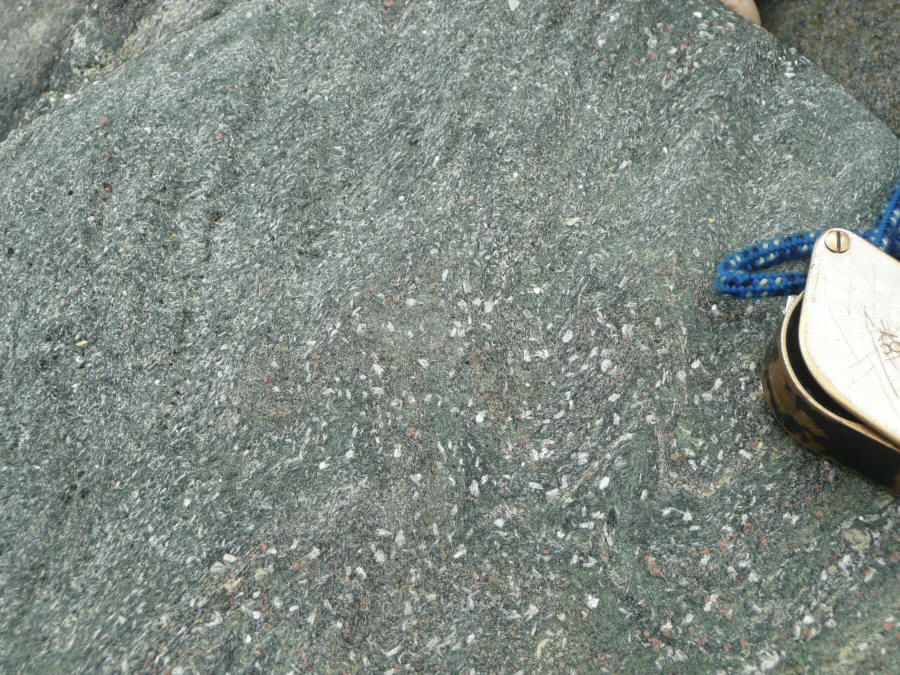
The proposed field trip will allow participants to view, investigate and sample most of the units described above, as well as key contact relationships where possible. For the early risers, rounded, wave-polished blocks of eclogites and other omphacite-bearing metabasites are exposed on the beach of the proposed headquarters hotel (Fig. 4). Other occurrences of eclogites and barroisite amphibolites rich in phengite and/or paragonite will be visited. Intimate contact relationships between the metabasic La Rinconada rocks and the pre-HP trondhjemites of the Guayacán Gneiss (Fig. 5), possibly indicative of anatexis of subducted oceanic crust (cf., Lázaro & García-Casco, 2008) can be seen near the hotel. We will examine examples of graphitic garnet-mica schists and feldspar-rich gneisses of the Juan Griego unit, as well as blocks of eclogite occurring as boudins and boudinaged layers within them. We will observe and discuss the significance of newly-discovered neosome/paleosome features (Paleozoic or subduction-related anatexis?) in the Juan Griego gneisses (Fig. 6). We will also visit metavolcanics of the lower-grade greenschist series. The menu will include metamorphosed ultrabasic rocks (mainly metadunite), as well as the prominent black-wall metasomatic rocks developed around them. A variety of intrusive rocks punctuate the geological record, and examples of most of these are accessible. Large intrusions of trondhjemite and many smaller satellite bodies are exemplified by the Guayacán Gneiss and the Matasiete Metatrondhjemite on Paraguachoa, as well as smaller bodies on Macanao. Granitic intrusions are represented by the El Salado Metagranite of Paraguachoa and the Macanao orthogneiss of Macanao. In addition, a number of smaller granitoid intrusions still awaiting more detailed study are scattered throughout the island. Similarly, small bodies of gabbro/diorite are common both in the HP/LT (Fig. 7) as well as the greenschist-facies units. Many late basic to intermediate dykes of small size but considerable aggregate volume are found throughout the island.
Fig. 4. Boulder of paragonite-rich amphibole-eclogite. Playa of Dunes Beach Hotel, Isla Margarita
Fig. 5A: Contact relationships observed between Guayacán Gneiss (metatrondhjemite) and metabasic rocks of La Rinconada unit.
Fig. 5B: Contact relationships observed between Guayacán Gneiss (metatrondhjemite) and metabasic rocks of La Rinconada unit.
Fig. 6: Neosome/paleosome features in gneiss of the Juan Griego unit.
Fig. 7: Strongly sheared gabbro/diorite.
References cited:
Avé Lallemant, H. G. 1997. Transpression, displacement partitioning, and exhumation in the eastern Caribbean/South American plate boundary zone. Tectonics, 16, 272-289.
Chevalier, Y., Stephan, J.-F., Darboux, J.-R., Gravelle, M., Bellon, H., Bellizzia, A. & Blanchet, R. 1988. Obduction et collision pré-Tertiaire dans les zones internes de la Chaîne Caraїbe vénézuélienne, sur le transect Ile de Margarita-Pénínsule de Araya. Comptes rendues de la Academie des Sciences Paris, 307(II), 1925-1932.
Guth, L. R. & Avé Lallemant, H. G. 1991. A kinematic history for eastern Margarita Island, Venezuela. In: Larue, D.K., and Draper, G. (eds) Transactions 12th Caribbean Geological Conference, 1989, St. Croix, Miami Geological Society, 472-480.
Higgs, R. 2009. Caribbean-South America oblique collision model revised. In: James, K., Lorente, M.A., and Pindell, J.L. (eds) The Origin and Evolution of the Caribbean Plate, Geological Society of London, Special Publications, 328, 613-657.
James, K.H., Lorente, M.A., & Pindell, J. (eds) The geology and evolution of the region between North and South America, Geological Society of London, Special Publications, 328, 858 pp.
Lázaro, C. & García-Casco, A. 2008. Geochemical and Sr-Nd isotope signatures of pristine slab melts and their residues (Sierra del Convento mélange, eastern Cuba). Chemical Geology, 255, 120-133.
Maresch, W. V. 1975. The geology of northeastern Margarita Island, Venezuela: A contribution to the study of Caribbean plate margins. Geologische Rundschau, 64, 846-883.
Maresch, W.V., Kluge, R., Baumann, A., Pindell, J., Krückhans-Lueder, G. & Stanek, K.P. (2009) The occurrence and timing of high-pressure metamorphism on Margarita Island, Venezuela: a constraint on Caribbean –South America interaction. In: James, K.H., Lorente M.A. & Pindell, J.L. (eds) The Origin and Evolution of the Caribbean Plate, Geological Society of London Special Publication, 328, 705-741 (2009).
Pindell, J.L. & Kennan, L. 2009. Tectonic evolution of the Gulf of Mexico, Caribbean and northern South America in the mantle reference frame: an update. In: James, K.H., Lorente, M.A., and Pindell, J.L. (eds) The Origin and Evolution of the Caribbean Plate, Geological Society of London, Special Publications, 328, 1-55.
Rekowski F. & Rivas. L. 2005. Integración geológica de la isla de Margarita, estado Nueva Esparta. GEOS, Universidad Central de Venezuela, Caracas, 38, 97-98 (+ 242 p. and 18 maps in CD).
Stöckhert, B., Maresch, W. V., Brix, M., Kaiser, C., Toetz, A., Kluge, R. & Krückhans-Lueder, G. 1995. Crustal history of Margarita Island (Venezuela) in detail: constraint on the Caribbean plate-tectonic scenario. Geology, 23, 787-790.
Margarita Island is a resort area with a network of good roads. The furthest point on the island can be reached in less than 2 hours, and most outcrops are fairly easily accessible. We are therefore pursuing the option that all participants stay in the Hotel "Dunes" near Pedro Gonzalez on the north coast of Paraguachoa. It is hoped that IGCP money will be available to defray the cost of lodging (about $ 225-250 per person for six nights in a double room at this year’s prices). Participants will be expected to make their own travel arrangements to Margarita, but flight arrangements should be plentiful from anywhere in the world.
Because of the excellent logistics, we will be able to cover a lot of ground in four days. The exact itinerary can be held fairly flexible, and “outcrops on demand” or fervent on-site discussions can be accommodated. The last, fifth day will be allotted to a final round of discussion and deliberation, where each participant will have an opportunity to judge what he has seen in terms of his own experience, to agree or disagree with the views expressed by the field-trip leaders and possibly to suggest further cooperative research thrusts for solving outstanding problems. Presumably those involved with analogous geological situations along the northern border of South America will draw up the template to structure such a discussion, and we look forward to hearing from these colleagues well ahead of time.
The limiting factor will be the size of the bus available to us, so that the number of participants must be limited to ca. 20 persons. Please consider the following in your high-priority“to-do” list:
1) Contact walter.maresch@rub.de to lodge a serious expression of interest soon.
2) Contact IGCP 546 project leader Uwe Martens to apply for IUGS-UNESCO funds for lodging.
We look forward to seeing you in Margarita in November 2010!
last modified: 12.14.10 20:39 +0100