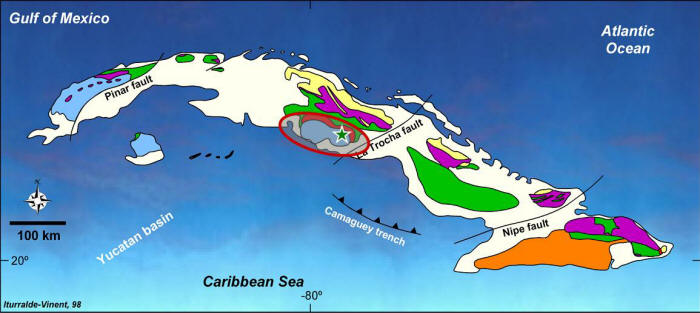
|

Image source: Modified by
García-Casco
et al., 2006 after Millán, 1997b. Geología del macizo metamórfico del
Escambray. In: Furrazola Bermúdez, G.F., Núñez Cambra, K.E. (eds.). Estudios
sobre Geología de Cuba. La Habana, Cuba, Centro Nacional de Información
Geológica, 271-288, with indication of major tectonic units, serpentinite
mélanges and amphibolite and eclogite bodies.
  
Image sources:
García-Casco
et al., 2006. High pressure metamorphism of ophiolites in Cuba.
Geologica Acta 4, 63-88;
Schneider et al., 2004. Origin and evolution of the Escambray Massif (central
Cuba); an example of HP/ LT rocks exhumed during intraoceanic subduction. Journal of Metamorphic Geology,
22, 227-247; and
Stanek et
al., 2006. Structure, tectonics and metamorphic development of the Sancti
Spiritus Dome (eastern Escambray massif, Central Cuba). Geologica Acta 4,
151-170) |
Millán (1997b) subdivided the terrane into four major tectonic units (I to IV,
numbered from bottom to top in the pile), each of which comprises a number of
smaller tectonic units. The lithological sequence consist of metacarbonatic and
metapsammopelitic rocks, with local metabasite intercalations. These rocks have
been correlated with non-metamorphosed Jurassic-Cretaceous continental margin
sequences of the Guaniguanico terrane of western Cuba, which formed part of the
borderland of the Maya block (Millán, 1997a, b; Iturralde-Vinent, 1996a;
Pszczólkowski, 1999). However, other reconstructions locate the terrane farther
southwest in the borderland of the Chortis block (Pindell and Kennan, 2001).
P-T conditions during metamorphism in the Escambray were variable (Millán,
1997b; Stanek et al., 2006), ranging from low grade at intermediate-P
(greenschist facies) and high-P (blueschist facies) to medium grade at high-P (eclogite
facies). The internal deformation is intense and complex, with numerous
tectonic-metamorphic inversions. The massif has an inverted metamorphic zoning,
with greenschist facies at the base in unit I, greenschist and lawsonite
blueschist facies in unit II, and epidote-blueschist and eclogite facies at the
top in unit III. The uppermost unit IV in contact with the overlying Mabujina
complex diverges from this pattern (greenschist-blueschist facies). High
pressure conditions indicate subduction of the continental margin. Subduction of
oceanic lithosphere is also documented by serpentinite matrix mélanges bearing
high-pressure exotic blocks. Available age data range from Upper Jurassic (U-Pb
age of zircon in eclogite, Maresch et al., 2003) through mid-Cretaceous (U-Pb:
106-100 Ma; Hatten et al., 1988, 1989) to Upper Cretaceous (K-Ar: 85-68 Ma;
40Ar/39Ar: 71-68 Ma; Rb/Sr: 65-69 Ma; Somin and Millán, 1981; Hatten et al.,
1988; Somin et al., 1992; Iturralde et al., 1996; Schneider et al., 2004).
Except for the Upper Jurassic age (discussed below), these ages are consistent
with subduction in the course of the Upper Cretaceous and exhumation during the
late Upper Cretaceous. This suggests that the associated subduction system may
be independent of the Lower Cretaceous subduction system recorded in the HP
blocks of mélanges from the northern ophiolite belt in western and central Cuba.
Petrologic evidence presented by García-Casco et al. (2006) supports this view.
Millán (1997b) and Schneider et al. (2004) identified blueschist
retrogression of eclogite facies rocks of tectonic unit III as a result of syn-subduction
exhumation during the late Upper Cretaceous. These authors also noted that the
prograde metamorphic evolution of coherent eclogite samples present in the
metasedimentary formations is more complex than that of the eclogite blocks of
the tectonically intercalated strips of serpentinite-mélanges, but that their
peak eclogite conditions and retrograde evolutions are similar, the latter
characterized by substantial cooling upon exhumation. Age data for an eclogite
block within a serpentinite-mélange body from unit III are 40Ar/39Ar (phengite):
69.3±0.6, 40Ar/39Ar (barroisite): 69.1±1.3 and Rb/Sr (whole
rock-phengite-barroisite): 66.0±1.7 Ma(Schneider et al., 2004). These figures
are interpreted as cooling ages close to thermal peak. The sample is made of a
peak mineral association is composed of almandinic (type-C) garnet, sodic-calcic
(barroisite) amphibole, omphacite, epidote, phengite, quartz, rutile and
apatite, which is typical of amphibole-eclogites. Garnet porphyroblasts include
epidote, sphene, rutile, amphibole, omphacite and quartz. These inclusions are
oriented along an internal foliation oblique to the external foliation. Garnet
zoning is concentric, typical of prograde growth, with cores richer in Fe, Mn
and Ca, and rims richer in Mg and Mg#. This zoning pattern is disturbed by
mechanical rupture of grains during deformation before attainment of the
metamorphic peak. The primary assemblage is irregularly replaced by a post-kinematic
retrograde assemblage consisting of actinolite, glaucophane, albite, (clino)zoisite
and chlorite, indicative of blueschist facies conditions. Small grains of
glaucophane overprint prograde barroisite, omphacite and garnet. At sites where
glaucophane grew adjacent to garnet, its composition is richer in Fe and Al,
while it is richer in Mg at sites dominated by amphibole and/or omphacite,
indicating diffusion problems during retrogression.
P-T paths are clockwise, with prograde sections within the eclogite field
followed by strong cooling during decompression. That the retrograde P-T path
involves substantial cooling, as is typical for Franciscan-type paths, is
indicative of a low geothermal (i.e., refrigerated) gradient during exhumation,
implying that subduction did not stop during late Cretaceous mélange formation
and exhumation. This scenario appears to contradict the thermal-tectonic
evolution of the early Cretaceous subduction zone where the blocks contained
within serpentinite mélanges from the northern ophiolite belt in western-central
Cuba were metamporphosed. |